
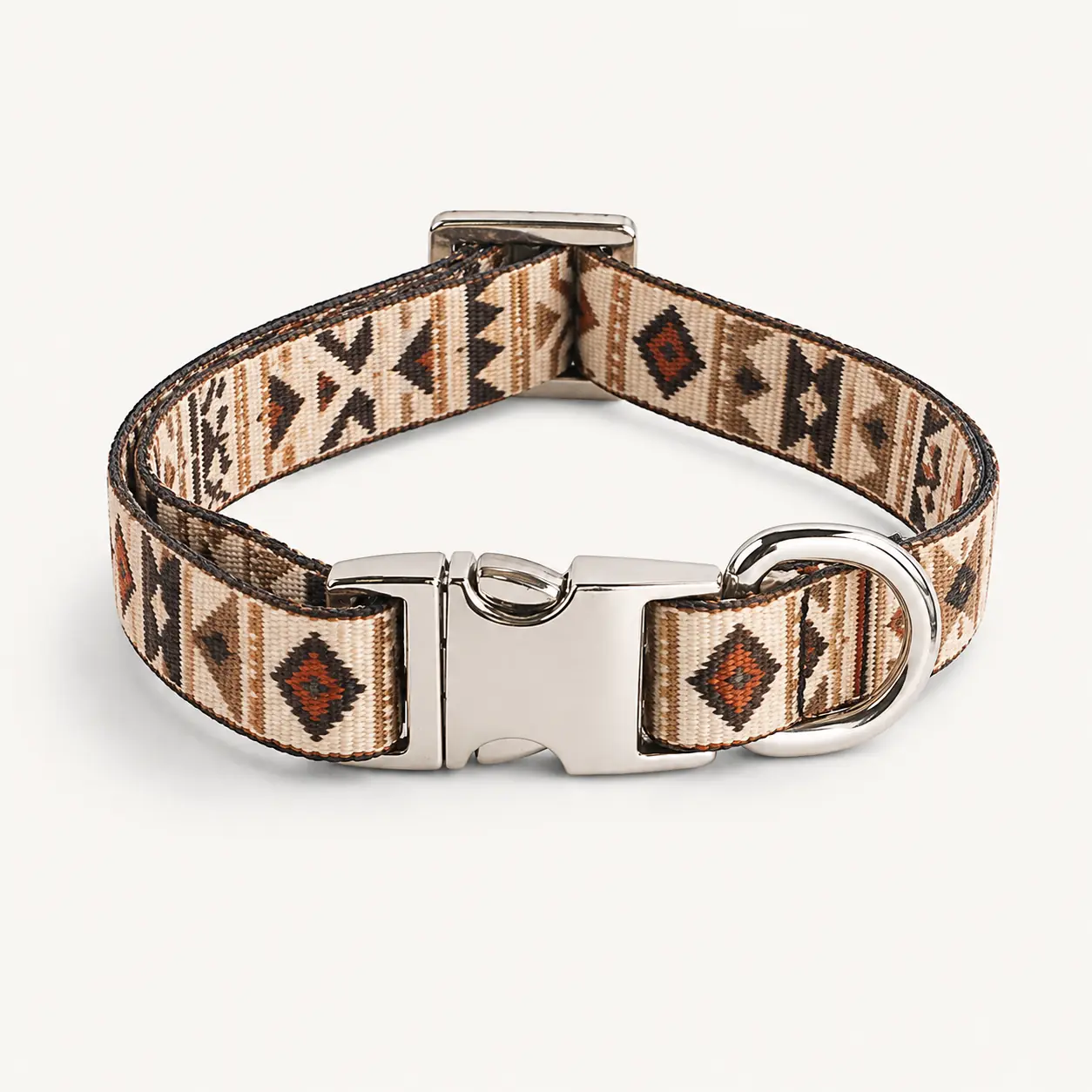
Define what “custom” means for your order
A custom dog collar can mean a repeated brand logo, exclusive artwork, a new construction or a different pet name on each piece. Those are different purchasing briefs. This guide focuses on custom and wholesale dog collars for pet brands, retailers and distributors.
For a listed wholesale style, identify the product and option codes, then ask about availability and quantities by size and color. For a private-label program, list the changes to material, hardware, artwork and packaging. If you need individual names or phone numbers, ask about that process separately before committing to the order.
Compare collar constructions
Choose two or three relevant constructions for sample review. A style name is a starting point; check the actual closure, adjustment and lining on each reference.
| Direction | Decisions to confirm | Product reference |
|---|---|---|
| Printed webbing | Artwork repeat, print orientation, width, buckle position and lining. | Custom printed collar |
| Padded / reflective | Lining coverage, reflective placement, edge finish and available neck ranges. | Reflective padded collar |
| Tactical | Webbing width, hardware, reinforcement and any specifically requested patch or handle. | Tactical collar program |
| Martingale | Loop construction, adjustment limits and fitting instructions for the intended range. | Martingale collar program |
When comparing nylon and polyester options, request the material specification and a sample of the proposed webbing. Review construction, finish and artwork together using the webbing selection guide; a fiber name alone does not describe the complete collar.
Approve neck ranges and webbing widths
Record minimum and maximum neck adjustment, webbing width and the measurement method for each size. Keep the dog’s body measurement separate from the finished collar dimensions. Letter sizes such as M or L need a measurement table to be useful across suppliers.
For example, the HJ-009 reflective padded collar lists M at 1.5 cm wide / 30–40 cm neck adjustment, L at 2 cm / 33–50 cm, and XL at 2.5 cm / 40–65 cm. These are that product’s reference dimensions, not a universal size chart.
Agree tolerances and review adjustment, buckle operation and lining on the sample. The collar and harness sizing guide explains how to document the measuring points and approved revision.
Choose branding around the usable area
A repeated logo, all-over artwork and an individual pet name need different layouts. Ask which application methods suit the selected webbing, padding and hardware. Review logo dimensions, position and colors at both adjustment limits.
- Brand labels or patches: confirm attachment, edge finish and the area available after assembly.
- Printed artwork: approve repeat length, direction and the visible design around buckles and folded ends.
- Individual names: confirm feasibility, text limits, the order-file format and how each piece will be checked and packed.
- Matching collections: approve collar and leash artwork together; different widths may need separate layouts.
Use the collar and leash set program to define the included pieces, shared packaging and quantity per retail SKU.
Compare samples and quotations on the same basis
Check the closure, adjustment movement, D-ring attachment, stitching, lining edges, artwork and labels. Agree any performance test method and acceptance criteria for the finished construction. Keep the accepted sample and specification revision linked to the order.
Send one quantity breakdown by style, size and color, along with packaging, target market and required delivery date. Ask whether the quoted minimum applies to the style, color or design, and separate product, sample, setup, packaging and freight charges where applicable.
Use the quality inspection checklist for sample review and the RFQ checklist and editable workbook to prepare a comparable quotation request.